Art
City

Catalog view is the alternative 2D representation of our 3D virtual art space. This page is friendly to assistive technologies and does not include decorative elements used in the 3D gallery.
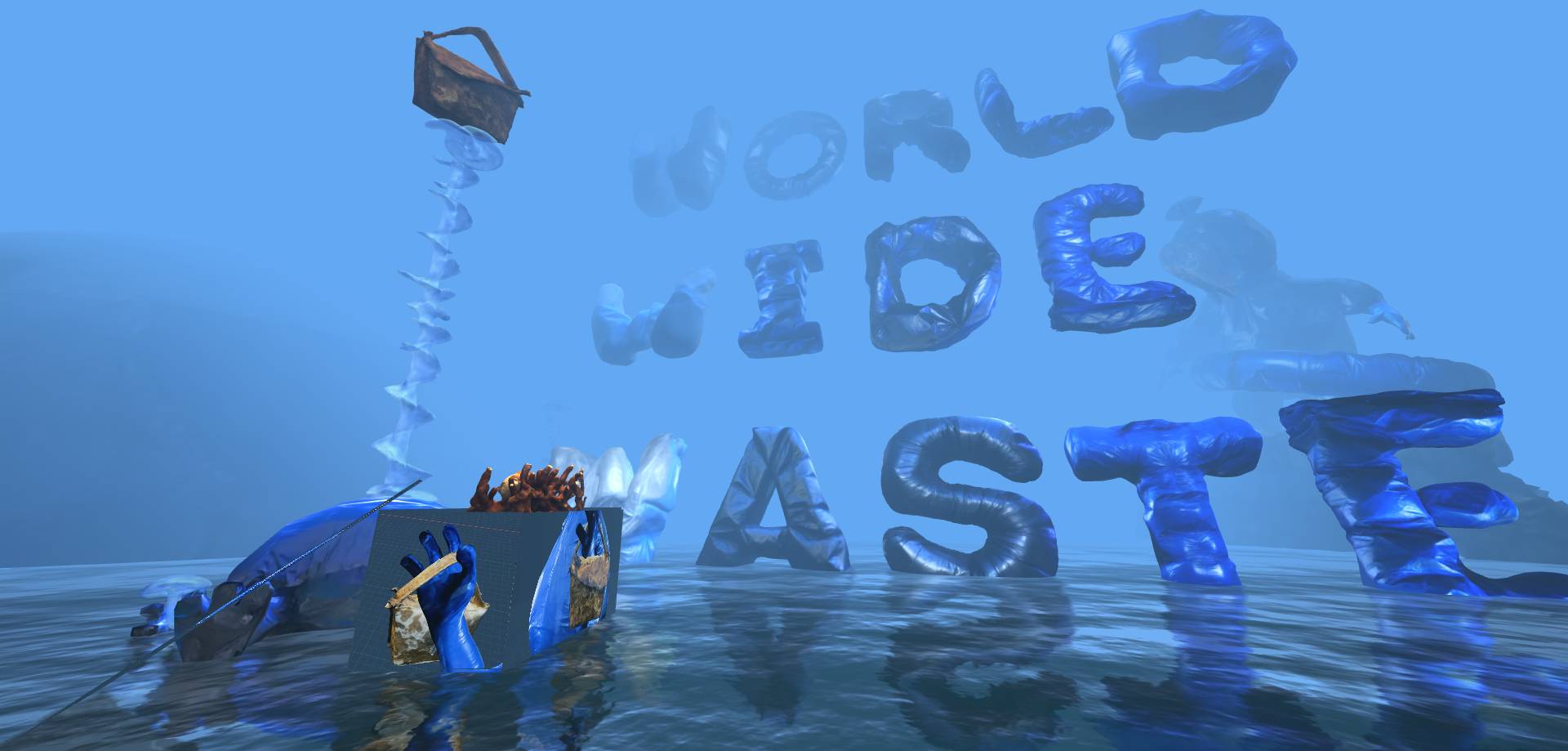
WORLD WIDE WASTE
Spaces in this world:
Statement:
Discover the fungi-powered way to transform waste into prima materia!
WORLD WIDE WASTE is an Open-Access Mycofabrication School and multispecies collaboration exploring the intersection of fashion waste and fungi. This virtual lab-exhibition highlights our entangled relationships with more-than-human life forms and underscores the importance of sustainable art practices.
Andrea Bonfini/FADE OUT LABEL, Asimina Sarli, Mycelionaires, Sigrid Savva, TOP lab, Fomes Fomentarius, Ganoderma Lucidum, Ganoderma Applanatum , Ganoderma Sessile, Xristina Sarli
SYLIA TEAM
Alessandro Volpato, Bea Brückner, Giulio Perticari, Giulia Ciola, Tamara Núñez Guitar, Xristina Sarli
3D Environment Description:
World Wide Waste: A More-Than-Human Open-Access Mycofabrication School
We often communicate who we are through our clothing, yet the global fashion industry has created vast waste streams that demand new solutions. Enter the World Wide Waste project—a more-than-human, open-access school where mycelium-based methods—ranging from mushroom leather to plastic-eating fungi—offer a blueprint for regenerative design.
Curated by Xristina Sarli—a mycohacker, bioartist, biodesigner, XR artist, and art-science-technology researcher—in collaboration with sustainability activists, artists, researchers and other than human living organisms World Wide Waste features solution-oriented works that highlight the transformative power of mycelial tools and knowledge. These imaginative yet practical approaches encompass mycoremediation (from the Greek μύκης “fungus” and the Latin remedium “restoring balance”), harnessing fungi’s natural ability to decontaminate our planet—a crucial strategy for reducing pollutants in soil, water, and beyond.
In this virtual, more-than-human world, participants are invited to heal their “future imagination” by engaging with living systems that foster new materials, novel resource cycles, and actionable hope. Through rethinking waste, challenging false fears, and learning from fungal intelligence, the project envisions a reality where every discarded garment or toxic spill becomes the starting point for ecological renewal.
P.S. Learn how to cultivate “mushroom leather” on your old T-shirt or jeans, transforming everyday waste into prima materia with the help of fungi:
ARTISTS, RESEARCHERS, DIWO DITO COMMUNITIES, LIVING ORGANISMS:
Andrea Bonfini , FADE OUT LABEL, Asimina Sarli, Mycelionaires, Sigrid Savva, TOPLab, , Fomes Fomentarius, Ganoderma Lucidum, Ganoderma Applanatum , Ganoderma Sessile, Xristina Sarli
SYLIA TEAM
Alessandro Volpato, biologist
Bea Brückner, material designer
Giulio Perticari, CEO
Giulia Ciola, material designer
Tamara Núñez Guitar, biotechnologist, art-science researcher
Xristina Sarli, Mycoskin R&D, curator, XR Mycokits, art-science-technology researcher
MIND THE FUNGI TEAM
Prof. Vera Meyer, Bertram Schmidt, Carsten Pohl (Deptm. Applied and Molecular Microbiology)
Prof. Peter Neubauer, Stefan Junne, Zakieh Zakeri, Martin Drostert (Deptm. Bioprocess Engineering)
Regine Rapp & Christian de Lutz (ALB)
Theresa Schubert (artist, Berlin)
Fara Peluso (artist, designer, Berlin)
Alessandro Volpato, Flavia Barragan, Tuçe Erel (TOP Lab, Berlin)
Artworks in this space:
We Are What We Wear
“We can’t measure intelligence, but we can measure stupidity — in tonnes of waste.”
This work begins with that truth. It grows from the ruins of overproduction and the myth of endless newness. Here, discarded garments are not dead materials but fertile soil. Fungi — the silent architects of decay and rebirth — become collaborators, digesting human excess, weaving their mycelial threads through shredded denim and cotton like veins of memory.

This piece blurs the boundary between body and earth, fashion and organism. It asks: what if what we wear could heal what we’ve broken? The fabrics breathe, bloom, and rot — a meditation on the cycles of creation and collapse that define our species.

We Are What We Wear is both an elegy and a blueprint. It doesn’t promise beauty — it exposes it. It invites us to face the truth that our waste is our reflection, and our only redemption lies in listening to the intelligence of what we once called decay.
Curator´s Tour
Next Stream: Bioglitch Performance — 13 December 2025, Mycohacking the Future space
Featuring Alexandra Maciá, Giorgio Alloatti, and Xristina Sarli.
This live event merges sound, biofeedback, and code, using plastic-eating fungi to distort VHS and audio tape recordings composed of polyurethane — transforming synthetic waste into sonic and visual decay.

Bioartist, XR artist, developer, and curator Xristina Sarli presents the works and research within each space of the PRIMA MATERIA Pavilion. The tour guides visitors through the interconnected worlds of Prima Materia, World Wide Waste, Decomposers, and Mycohacking the Future, unfolding how bioart, AI, and regenerative design intersect across the exhibition.

In the coming months, a series of talks, performances, and workshops will be streamed directly from each pavilion space and announced both here and via TOP Lab’s website
.
“Mycelium Libraries” and the Mushroom Lifecycle PART 0: PREPARE THE TUBES
PREPARE THE TUBES

1. Prepare and Sterilize
Sterile Microtubes

Use small, autoclavable microcentrifuge tubes (commonly 1.5–2 ml) or similar containers.
Sterilize tubes (and any tools) by autoclaving or pressure cooking at 15 psi for 15–20 minutes.

2. Prepare Distilled Water

Use fresh, sterile distilled water.

1. Autoclaving
-Fill the Autoclavable Container

Use glass or autoclavable plastic bottles/flasks.
Leave headspace (about 20% of the volume) to allow for expansion during heating.

-Cover Loosely

Loosen the cap or cover with foil to let steam escape and prevent vacuum formation.

-Autoclave Cycle

Place in an autoclave at 121°C (15 psi) for 15–20 minutes (longer for larger volumes).
Let the pressure release and the water cool inside the autoclave to avoid sudden temperature changes.

-Tighten / Seal

Once cool, tighten the cap or cover to maintain sterility.
Label the container with the date of sterilization.
“Mycelium Libraries” and the Mushroom Lifecycle PART 1: STARTING A MOTHER CULTURE (MASTER MICROTUBE CULTURE)
A Note on “Mycelium Libraries” and the Mushroom Lifecycle
Imagine each microtube of mycelium as a “book” in a living library. When you “check out” this culture, you’re not just borrowing information; you’re expanding it into new “editions” across multiple jars. Eventually, you can “loan out” healthy portions to grain spawn and then to bulk substrates—like reprinting a popular title for a wider audience.

Each mushroom growth cycle can loop back into the library. At any stage, you can create a new master culture by isolating clean mycelium onto fresh agar. In other words, the mushroom lifecycle is far more than “grow once and toss.” It’s a continuous, circular process of expansion, refinement, and archiving—one that can keep your fungal “library” stocked with healthy, pure cultures for years to come.

INOCULATION STEPS

1. Prepare Your Sterile Workspace

Still Air Box (SAB) or Laminar Flow Hood
A SAB is a simple plastic tote with two armholes that reduces air currents and contaminants.
If you have the means and space, a laminar flow hood provides a constant flow of HEPA-filtered air.

DIY FLOW HOOD:
 (https://learn.freshcap.com/wp-content/uploads/2020/05/DIY_Flow_Hood_Plans_FreshCap_Mushrooms-edited.pdf)

DIY SAB BOX:
(https://shroomok.com/en/wiki/Still_Air_Box_for_Mycology)

2. Sanitize Everything

Clean the SAB: Wipe down all inner surfaces with soapy water or a disinfectant solution to reduce airborne particles.
Disinfect Tools:
Use isopropyl alcohol (70% or higher) to wipe down scalpel handles, inoculation loops, jar exteriors, and gloved hands.
Have a flame source (e.g., butane torch or alcohol lamp) ready for sterilizing metal tools.

3. Transfer Your Mother Culture

Flame Sterilize/Single Use Scalpel or Inoculation Loop

-Heat your scalpel blade or inoculation loop until it’s red-hot.
Let it cool briefly (still in a sterile environment).

-Open the Microtube (Inside the SAB)

-Carefully pop the lid on your microtube containing the mother mycelium.

-Use your sterilized tool to extract a small piece or scoop of mycelium.
Inoculate Your Jar

-Agar Jar: Remove the lid of the jar /petridish (with solid agar) inside the SAB/Laminar Flow Hood. Quickly place the mycelium piece onto the agar surface.

-Close & Seal

Tighten the jar lid to secure a sterile environment.
Label the jar with date, strain/species, and note that it came from the microtube mother culture.

INCUBATION & OBSERVATION

-Store Properly

Ideal temperature for most mushroom species: ~22–27°C (72–80°F).
-Keep the jars in a clean area away from direct sunlight.

-Check for Growth

Within days or up to two weeks (depending on the species), look for white mycelial strands radiating from the inoculation point.

-Monitor Contamination

Contaminants typically appear as green, black, or pink spots, or come with an off odor.
If a jar is contaminated, isolate or discard it to protect your other cultures.

FURTHER STEPS IN THE MYCELIUM CYCLE

-Transfer or Rescue

If part of a jar is clean and part contaminated, you can often rescue the healthy mycelium by transferring it to a new sterile jar. Repeat until fully clean.

-Expand to Grain Spawn

Once you have a robust, uncontaminated culture on agar (or in liquid), move it to sterilized grain jars or bags to create grain spawn.
The mycelium will colonize the grain, forming a solid white mass.

-Spawn to Bulk Substrate

Use the fully colonized grain to inoculate a bulk substrate (e.g., coco coir, straw, hemp or manure-based compost).
This step supports fruiting, where you finally see mushrooms emerge.

TIPS & REMINDERS

-Sterile Technique is Key: The filter (cotton, polyfill, or other micropore) allows gas exchange but blocks most contaminants. Always flame sterilize and disinfect diligently.

-Lid Tightness: After sterilization, some jars may create a vacuum or swell. You may need to adjust how firmly you screw on lids or add foil during sterilization to avoid moisture loss.
Humidity & Moisture: Jars with agar should retain enough moisture on their own. Avoid drying out the surface—keep lids closed and rely on minimal gas exchange through the filter.

-Label Everything: Mark each jar with the inoculation date and strain/species to track your progress.

WHY JAR-BASED CULTURES?

Using glass jars as makeshift Petri dishes or culture vessels is a cost-effective, low-waste approach. By drilling a hole in the lid, stuffing it with cotton or polyfill for filtration, and sterilizing the entire setup, you can maintain a relatively sterile environment. Jars are repurposed, reusable and reduce single-use plastic.

RESTARTING THE CYCLE

Any time you cultivate a healthy mycelial colony, you can create new backups by transferring pieces of clean mycelium onto fresh agar plates (or jars), or in distilled water microtubes and back to the library. In this way, your “living library” continuously expands, ensuring fresh sources of healthy culture. If a particular strain proves useful or interesting, you can store it indefinitely—like a favorite book you come back to over and over.

FINAL THOUGHTS

Starting from a mother microtube culture is like opening a chapter in an ever-evolving story. With proper sterile technique, mindful observation, and good record-keeping, you can keep your fungal library thriving—ready to branch out into new substrates, new experiments, and new frontiers in the circular world of mycology.
“Mycelium Libraries” and the Mushroom Lifecycle PART 2: REVIVING A CULTURE
MUSHROOM LIBRARY

Imagine each microtube of mycelium as a “book” in a living library. When you “check out” this culture, you’re not just borrowing information; you’re expanding it into new “editions” across multiple jars. Eventually, you can “loan out” healthy portions to grain spawn and then to bulk substrates—like reprinting a popular title for a wider audience.

Each mushroom growth cycle can loop back into the library. At any stage, you can create a new master culture by isolating clean mycelium onto fresh agar. In other words, the mushroom lifecycle is far more than “grow once and toss.” It’s a continuous, circular process of expansion, refinement, and archiving—one that can keep your fungal “library” stocked with healthy, pure cultures for years to come.

1. Reviving

To revive, open the tube in a sterile workspace (SEE INOCULATION TUTORIALS FOR SAB/FLOW HOOD), remove a small piece of mycelium, and place it on fresh agar.
Watch for healthy, white mycelial growth within a week or two.
If clean, you can expand it to grain spawn or additional agar plates.

2. Refresh Your Library ( SEE PART 1)

If you plan on long-term culture (years), periodically make fresh tubes (e.g., every 12 months) from a newly grown, healthy colony to prevent senescence.

3. Best Practices & Tips

Keep Backups: Maintain multiple copies of important strains (e.g., a tube at home, a tube in a friend’s fridge, or a second method like an agar slant).

4. Limit Tube Opening: Only open the microtube in a sterile environment to reduce contamination risk.
Track Everything: Good labeling and record-keeping are crucial. Note down the date of storage, strain ID, and any special observations.

Plan for the Long Haul: If you need to store cultures for several years, consider cryopreservation or oil overlay methods as more robust alternatives.

5. Final Thoughts
Storing mycelium in distilled water is a cost-effective, straightforward method for maintaining a living library of mushroom strains. With careful sterile technique, stable cool temperatures, and periodic checks, you can preserve genetic material for up to a couple of years—allowing quick revival and expansion of your favorite or most valuable fungal allies.
Seal and Label
Label each jar with date and strain/species.
Ancient Mother Mycelium, Mushroom Leather Mistresspieces
microscopy recordings and Asimina Sarli crocheting

"Unseen and forgotten
Working tirelessly and graciously to restore the earth.
We see you, we feel you, we honor you. "

Excerpt from (Ancient Mother Mycelium Poem by Melissa Robbins-Eugene)


Mother Mycelium is the unseen architect of our natural world—humans included—an underground network of fungal threads that binds soils, roots, and entire ecosystems. Hyphae pushing through the darkness: these filamentous strands behave much like textile fibers, weaving and knotting themselves into a flexible mesh that holds substrates in place. Whether it’s hugging decomposing wood or stretching beneath a forest floor, mycelium’s ‘fabric’ exudes a gentle persistence—whispering reminders that growth, healing, and renewal often happen in hidden places. By connecting so many disparate elements, Mother Mycelium stands as a testament to the unseen power of ancient queendoms—quietly weaving a living tapestry that sustains countless life forms, including our own.


For the Ancient Mother Mycelium Leather series, I upcycled the “aged doilies” passed down from my mother, grandmother, and great-grandmother—delicate cotton heirlooms yellowed by time. I offered these cherished pieces to the Fomes fomentarius fungus, curious to see how an ancient artistry might blossom into something new. Far from an act of disregard or irreverence, this was a tribute—a living dialogue between past and future.

It felt profoundly moving to honor the hands that wove my lineage into being. Each thread is steeped in the essence of maternal care, whispering of trust, nourishment, and love. My tears flow with the memory of an infant’s vulnerable wonder, knowing nothing but the certainty of being cradled.

Feeding the mycelium with these mother-made doilies is a gesture of gratitude. It is a letter from the future child to its ancestral mothers—both human and fungal—saying:

“Thank you for weaving us into existence. Your knowledge is the loom upon which we grow ever more resilient and creative. This new hybrid, born of tradition and innovation, bears your imprint. Please receive our offering, witness our art, and forgive our audacity in bridging old and new. We carry your magic forward, forever shaped by your gentle "hands".
Mycelium Colonised Substrate
Photogrammetry scan of a 25 days grown colonised substrate.
Fomes Fomentarius
Photogrammetry scan of a 25 days grown colonised substrate, Polycam, Blender
Mycelium grown on upcycled fabrics
P
DENIM HEART
This is a soft, heart-shaped sculpture. It's a clash between FADE OUT Labels patchwork metho made of upcycled jeans , and the original shape of the surreal brand ”Aufschnitt Berlin”. Courtesy Hannes Klein Archives
Berlin, 2022

Andrea Bonfini-FADE OUT LABEL
FADE OUT LABEL was born in Berlin in early 2015 by Andrea Bonfini, owner and director of the brand. Unisex, Zero Waste and Unique garments with an oversized fit made of deconstructed vintage denim and upcycled fabrics are what FADE OUT LABEL collections are made of. Opposed to the fast-paced requirements of the fashion industry, FADE OUT LABEL celebrates “timeless creativity” and the originality of every single idea and item. The brand has a permanent collection to which new pieces are added every season or whenever the designer feels ready to introduce new ideas. FADE OUT LABEL  realizes all the development and production of garments in its Berlin atelier with an innovative style and tailored with handicraft quality which, due to the use of recycled material, become hand-crafted one-offs—repeatable but always different.
YOU ARE WHAT YOU WEAR
Maxy dress  made of upcycled jeans, macro pailettes made of used tomato tins, waste materials.
"You Wear What You Are" is a fashion-Installation inspired by the Dada Artist, Elsa von Freytag Loringhoven, who made waste an Art... to wear!
FADE OUT LABEL has choosen to work primarily with denim, bought at charity stores or flea-market that is then deconstructed, washed, sanitized, ironed and reassembled in patchwork method as the tiles of a mosaic. The characteristic of jeans is to be a fabric that keeps the memory of time in the shades of its fading from wear. In addition the Berlin Wall era it was practically forbidden to wear jeans in the Deutsche Demokratische Republik. Blue jeans represented a forbidden Western culture, rebellion, and rock n' roll. The situation changed with the fall of the wall in 1989, but even today, jeans are a symbol of freedom in Berlin.

Andrea Bonfini-FADE OUT LABEL
FADE OUT LABEL was born in Berlin in early 2015 by Andrea Bonfini, owner and director of the brand. Unisex, Zero Waste and Unique garments with an oversized fit made of deconstructed vintage denim and upcycled fabrics are what FADE OUT LABEL collections are made of. Opposed to the fast-paced requirements of the fashion industry, FADE OUT LABEL celebrates “timeless creativity” and the originality of every single idea and item. The brand has a permanent collection to which new pieces are added every season or whenever the designer feels ready to introduce new ideas. FADE OUT LABEL  realizes all the development and production of garments in its Berlin atelier with an innovative style and tailored with handicraft quality which, due to the use of recycled material, become hand-crafted one-offs—repeatable but always different.
LADIES AND GENDERS
Deconstructed & Reassembled in Berlin _ est 2015
- denim-couture • unisex • zero-waste -
Andrea Bonfini-FADE OUT LABEL
FADE OUT LABEL was born in Berlin in early 2015 by Andrea Bonfini, owner and director of the brand. Unisex, Zero Waste and Unique garments with an oversized fit made of deconstructed vintage denim and upcycled fabrics are what FADE OUT LABEL collections are made of. Opposed to the fast-paced requirements of the fashion industry, FADE OUT LABEL celebrates “timeless creativity” and the originality of every single idea and item. The brand has a permanent collection to which new pieces are added every season or whenever the designer feels ready to introduce new ideas. FADE OUT LABEL  realizes all the development and production of garments in its Berlin atelier with an innovative style and tailored with handicraft quality which, due to the use of recycled material, become hand-crafted one-offs—repeatable but always different.

Instagram: @fadeoutlabel https://www.instagram.com/fadeoutlabel/
DENIM WASTE
Checking the denim waste for pieces that contain elasticine as its plastic material and therefore not biodegradable
GROWING MUSHROOM LEATHER ON FASHION WASTE
#post-consumer recycled denim #zero waste #mycelium leather

During the SYLIA project, Xristina Sarli ( SYLIA ex  co-founder, bioartist and researcher)  and Tamara Núñez Guitar (Biotechnonoligist, Researcher) worked together in research and development on MYCOSKIN grown on fabric waste mainly denim for the World Wide Waste collaboration with sustainablle fashion design label  FADE OUT . FADE OUT label  creates slow fashion unisex zero waste garments from retail/ cloth waste. To highlight the future of materials and make clear the zero waste aspect in the circular fahion model we documented the process and  share in this Virtual School providing all tutorials and recipes.


The Process

-Gathering Denim Offcuts

While creating an upcycled garment, Xristina and Tamara collected the smallest fabric fragments—flocks, offcuts, and even tiny slivers—left over from FADE OUT’s production. These would otherwise have been discarded." so FADE OUT was creating the garment that Xristina and Tamara collected offcuts, is it clear?

-Feeding Fungi

The scraps became the growing substrate for Fomes fomentarius, a mushroom culture integral to the MYCOSKIN process.
Small Denim Pieces: Blended with agricultural and organic waste to form a nutrient-rich medium.
Larger Denim Pieces: Laid out in a puzzle-like patchwork for the mycelium to weave together into one cohesive sheet.

-Mushroom Leather Formation

As the mycelium colonizes the denim scraps, it creates a strong, leather-like layer. Even large patches fuse seamlessly, demonstrating how mycelium’s natural growth can bind disparate materials into a durable, single surface.

-Finishing & Preservation

For the World Wide Waste series, the MYCOSKIN was treated only with glycerin to maintain the mushroom’s natural texture, aroma, and coloration. Hues range from rich browns to soft reds, ecru, and white, reflecting the organic interaction between the fungus and the denim fibers.


Why It Matters

-Zero Waste

This process repurposes “the rest of the rests,” ensuring that even the tiniest scraps of denim find new life rather than ending up in landfills.

-Open-Source Collaboration

By sharing tutorials and recipes, the WWW project aims for an open-source approach that invites more designers, makers, and researchers to adopt and adapt these methods.

-Circular Fashion

The resulting MYCOSKIN exemplifies a truly circular material, harnessing nature’s own decomposition and regeneration cycle to turn waste into a functional, sustainable textile.

-Multispecies Partnership

This endeavour underscores the possibility of co-creation with fungi, opening up innovative pathways for designing our future with ecosystems, rather than simply extracting resources from them.
In short, the WWW project with FADE OUT showcases a groundbreaking approach to material innovation—demonstrating how mycelium and denim waste can fuse into a new, leather-like textile. This more-than-human partnership stands as a testament to the potential of mycofabrication, mycoremediation, upcycling, and open-source knowledge in reshaping our fashion and waste landscapes.
The word "waste" comes from the Old Northern French word waste(e) which is based on the Latin vastus, meaning "unoccupied" or "uncultivated" I am wasting You are wasting He/She/It is wasting We are wasting You are wasting They are wasting I was wasting You were wasting He/She/It was wasting We were wasting You were wasting They were wasting DEFINITION OF WASTE Verb To use or expand carelessly, extravagantly, or to no purpose Noun An act or instance of using or expanding something carelessly, extravagantly or to no purpose. I will not waste You will not waste We will not waste
DENIM GROWN MYCOCOMPOSITES
To document and demonstrate mycelium growth on denim waste, four different mycocomposites were prepared and dehydrated at various growth stages: 2 days, 4 days, 7 days, and 10 days. This is the final 10-day sample, which will now be dehydrated and 3D scanned. At this stage, the mycelium begins to develop its outer "skin," causing the initially white surface to transition to a cream-brownish color, gradually thickening and hardening over time. The optimal harvest period for "Mycoskin" (Mushroom Leather or Mycelium-Based Leather) is between 14 and 28 days, when the material reaches its ideal texture and durability.
Denim Grown Mycocomposite 10 Days Old
3D Scan of ten-day-old denim grown mycocomposite

To document and demonstrate mycelium growth on denim waste, four different mycocomposites were prepared and dehydrated at various growth stages: 2 days, 4 days, 7 days, and 10 days. This is the final 10-day sample, which will now be dehydrated and 3D scanned. At this stage, the mycelium begins to develop its outer "skin," causing the initially white surface to transition to a cream-brownish color, gradually thickening and hardening over time. The optimal harvest period for "Mycoskin" (Mushroom Leather or Mycelium-Based Leather) is between 14 and 28 days, when the material reaches its ideal texture and durability.
Denim Grown Mycocomposite 7 Days Old
3D Scan of seven-day-old denim grown mycocomposite

To document and demonstrate mycelium growth on denim waste, four different mycocomposites were prepared and dehydrated at various growth stages: 2 days, 4 days, 7 days, and 10 days. This is the final 10-day sample, which will now be dehydrated and 3D scanned. At this stage, the mycelium begins to develop its outer "skin," causing the initially white surface to transition to a cream-brownish color, gradually thickening and hardening over time. The optimal harvest period for "Mycoskin" (Mushroom Leather or Mycelium-Based Leather) is between 14 and 28 days, when the material reaches its ideal texture and durability.
Denim Grown Composite 4 Days Old
3D Scan of four-day-old denim grown mycocomposite

To document and demonstrate mycelium growth on denim waste, four different mycocomposites were prepared and dehydrated at various growth stages: 2 days, 4 days, 7 days, and 10 days. This is the final 10-day sample, which will now be dehydrated and 3D scanned. At this stage, the mycelium begins to develop its outer "skin," causing the initially white surface to transition to a cream-brownish color, gradually thickening and hardening over time. The optimal harvest period for "Mycoskin" (Mushroom Leather or Mycelium-Based Leather) is between 14 and 28 days, when the material reaches its ideal texture and durability.
Denim Grown Mycocomposite 2 Days Old
3D Scan of two-day-old denim grown mycocomposite

To document and demonstrate mycelium growth on denim waste, four different mycocomposites were prepared and dehydrated at various growth stages: 2 days, 4 days, 7 days, and 10 days. This is the final 10-day sample, which will now be dehydrated and 3D scanned. At this stage, the mycelium begins to develop its outer "skin," causing the initially white surface to transition to a cream-brownish color, gradually thickening and hardening over time. The optimal harvest period for "Mycoskin" (Mushroom Leather or Mycelium-Based Leather) is between 14 and 28 days, when the material reaches its ideal texture and durability.
DENIM GROWN MYCOCOMPOSITES
To document and demonstrate mycelium growth on denim waste, four different mycocomposites were prepared and dehydrated at various growth stages: 2 days, 4 days, 7 days, and 10 days. This is the final 10-day sample, which will now be dehydrated and 3D scanned. At this stage, the mycelium begins to develop its outer "skin," causing the initially white surface to transition to a cream-brownish color, gradually thickening and hardening over time. The optimal harvest period for "Mycoskin" (Mushroom Leather or Mycelium-Based Leather) is between 14 and 28 days, when the material reaches its ideal texture and durability.
MYCELIUM BASED LEATHER HARVEST AND POST PROCESSING
#post-consumer recycled textiles #zero waste #mycelium leather

During the SYLIA project, Xristina Sarli (SYLIA ex-co-founder, bioartist, and researcher) and other SYLIA team members collaborated on research and development for MYCOSKIN—a material grown on post-consumer textile waste using open-access recipes and methods shared in this virtual lab.

The Process

Finishing & Preservation

MYCOSKIN was treated solely with glycerin to preserve the mushroom’s natural texture, aroma, and coloration. The hues range from rich browns to soft reds, ecru, and white.

Why It Matters

Open-Access Collaboration
By sharing tutorials and recipes, the WWW project embraces an open-access approach that invites designers, makers, and researchers to adopt and adapt these methods.

Zero Waste Circular Fashion
MYCOSKIN exemplifies a truly circular material, harnessing nature’s own decomposition and regeneration cycles to transform waste into a functional, sustainable textile.

Multispecies Partnership
This endeavor highlights the potential for co-creation with fungi, opening innovative pathways for designing a future that works in harmony with ecosystems rather than simply extracting resources from them.

Mycofabrication practices showcase a groundbreaking approach to material innovation—demonstrating how mycelium and waste can fuse into a new, leather-like textile. This more-than-human partnership stands as a testament to the potential of mycofabrication, mycoremediation, upcycling, and open-access knowledge in reshaping our fashion and waste landscapes.
MBL PLYWOOD FINAL POST PROCESSING
#post-consumer recycled plywood lazer cut off-cuts #zero waste #mycelium leather

During the SYLIA project, Xristina Sarli (SYLIA ex-co-founder, bioartist, and researcher) and other SYLIA team members collaborated on research and development for MYCOSKIN—a material grown on waste using open-access recipes and methods shared in this virtual lab.

The Process

Finishing & Preservation
MYCOSKIN was treated solely with glycerin to preserve the mushroom’s natural texture, aroma, and coloration. The hues range from rich browns to soft reds, ecru, and white—reflecting the organic interplay between the fungus and denim fibers.

Why It Matters

Open-Access Collaboration
By sharing tutorials and recipes, the WWW project embraces an open-access approach that invites designers, makers, and researchers to adopt and adapt these methods.

Zero Waste Circular Fashion
MYCOSKIN exemplifies a truly circular material, harnessing nature’s own decomposition and regeneration cycles to transform waste into a functional, sustainable textile.

Multispecies Partnership
This endeavor highlights the potential for co-creation with fungi, opening innovative pathways for designing a future that works in harmony with ecosystems rather than simply extracting resources from them.

Mycofabrication practices showcase a groundbreaking approach to material innovation—demonstrating how mycelium and waste can fuse into a new, leather-like textile. This more-than-human partnership stands as a testament to the potential of mycofabrication, mycoremediation, upcycling, and open-access knowledge in reshaping our fashion and waste landscapes.
PREPARING MYCELIUM BASED LEATHER USING FUSIBLE LINING
In the FADE OUT STUDIO, Andrea Bonfini prepares the mycelium-based leather (MBL) in the studio before sewing, using fusible lining. Fusible lining is a fabric with an adhesive backing, applied to enhance stability and add body to the material.

FADE OUT LABEL

Deconstructed & Reassembled in Berlin _ est 2015
- denim-couture • unisex • zero-waste -

FADE OUT LABEL was born in Berlin in early 2015 by Andrea Bonfini owner and
director of the brand. Unisex, Zero Waste and Unique garments with an oversized fit
made of deconstructed vintage denim and upcycled fabrics are what FADE OUT
LABEL collections are made of.
Opposed to the fast-paced requirements of the fashion industry FADE OUT LABEL
celebrate “timeless creativity” and the originality of every single idea and item, the
brand has a PERMANENT collection to which new pieces are added every season or
whenever the designer feels ready to introduce new ideas.
FADE OUT LABEL realizes all the development and production of garments in its
Berlin atelier with an innovative style and tailored with handicraft quality which due
to the use of recycled material become hand-crafted one-offs, repeatable but always
different.

Instagram: @fadeoutlabel https://www.instagram.com/fadeoutlabel/
YOU ARE WHAT YOU WERE
At FADE OUT STUDIO, Andrea Bonfini works with diverse Mycoskins cultivated on his post-sewing textile waste.

FADE OUT LABEL

Deconstructed & Reassembled in Berlin _ est 2015
- denim-couture • unisex • zero-waste -

FADE OUT LABEL was born in Berlin in early 2015 by Andrea Bonfini owner and
director of the brand. Unisex, Zero Waste and Unique garments with an oversized fit
made of deconstructed vintage denim and upcycled fabrics are what FADE OUT
LABEL collections are made of.
Opposed to the fast-paced requirements of the fashion industry FADE OUT LABEL
celebrate “timeless creativity” and the originality of every single idea and item, the
brand has a PERMANENT collection to which new pieces are added every season or
whenever the designer feels ready to introduce new ideas.
FADE OUT LABEL realizes all the development and production of garments in its
Berlin atelier with an innovative style and tailored with handicraft quality which due
to the use of recycled material become hand-crafted one-offs, repeatable but always
different.

Instagram: @fadeoutlabel https://www.instagram.com/fadeoutlabel/
Harvesting Mycelium Skin
Video documentation, 2025

In this video, the artist carefully harvests sheets of mycelium skin — organic membranes grown over discarded denim fragments — revealing the slow choreography of collaboration between human and fungus. The post-process captures the moment where textile waste becomes a new material, transformed through the metabolism of Fomes Fomentarius.

Each gesture of peeling and revealing is both scientific and intimate: a dialogue between care, decay, and regeneration. The resulting mycelium-bonded fabric becomes the foundation for the GIY T-shirt and its organic pattern, a wearable archive of the XR layer experiment.

The work visualizes an alternative production cycle in which fashion materials are not manufactured but grown, not extracted but cultivated in symbiosis. It invites reflection on new modes of making — where human creativity and nonhuman intelligence intertwine in acts of mutual design.

#post-consumer recycled cashmere #zero waste #mycelium leather

During the SYLIA project, Xristina Sarli (SYLIA ex-co-founder, bioartist, and researcher) and other SYLIA team members collaborated on research and development for MYCOSKIN—a material grown on post-consumer textile waste using open-access recipes and methods shared in this virtual lab.

The Process

Finishing & Preservation

MYCOSKIN was treated solely with glycerin to preserve the mushroom’s natural texture, aroma, and coloration. The hues range from rich browns to soft reds, ecru, and white.

Why It Matters

Open-Access Collaboration
By sharing tutorials and recipes, the WWW project embraces an open-access approach that invites designers, makers, and researchers to adopt and adapt these methods.

Zero Waste Circular Fashion
MYCOSKIN exemplifies a truly circular material, harnessing nature’s own decomposition and regeneration cycles to transform waste into a functional, sustainable textile.

Multispecies Partnership
This endeavor highlights the potential for co-creation with fungi, opening innovative pathways for designing a future that works in harmony with ecosystems rather than simply extracting resources from them.

Mycofabrication practices showcase a groundbreaking approach to material innovation—demonstrating how mycelium and waste can fuse into a new, leather-like textile. This more-than-human partnership stands as a testament to the potential of mycofabrication, mycoremediation, upcycling, and open-access knowledge in reshaping our fashion and waste landscapes.
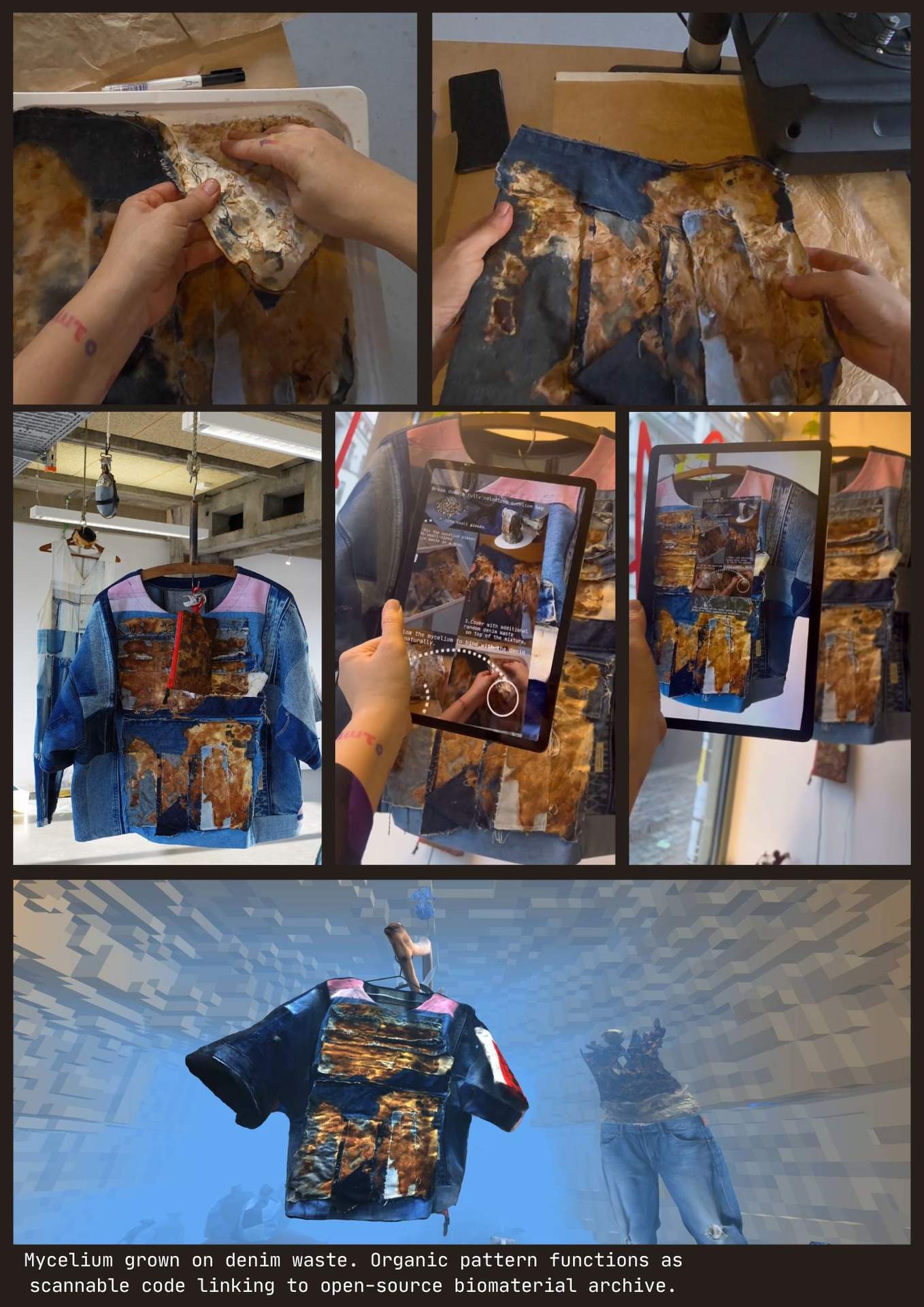
Organic QR CODE
Mycelium grown on denim waste. Organic pattern functions as scannable code linking to open-source biomaterial archive.

This collaborative work between FADE OUT Label, Xristina Sarli, and the fungus Fomes Fomentarius reimagines fashion as a regenerative ecosystem. Beginning with the unmakeable — denim scraps, frayed edges, and textile remnants deemed impossible to sew or reuse — the project invited fungi to become both designer and collaborator. Fed with discarded fabric, Fomes Fomentarius wove a natural hard skin, transforming waste into a new, leather-like material within a month.

Through this process, the mycelium stitched together what human tools could not — saving time, labor, and resources, and demonstrating an alternative material logic rooted in cooperation rather than extraction. The garments embody a more-than-human craft: a practice of listening, tending, and learning from nonhuman intelligence.

Each piece is both artifact and interface — the organic patterns grown by mycelium function as scannable codes, linking to an open-source biomaterial archive. These garments and accessories thus become a GIY (Grow-It-Yourself) database, inviting others to replicate, remix, and reimagine the process.

At its core, this work is a call for degrowth and regenerative design — a reminder that sustainable futures can only emerge through partnership with the living world. As imagination guides us to wisdom, fungi teach us that collaboration is not a metaphor but a method for survival.

HOW TO:

1.Break down a fully colonized mycelium bag into small pieces.

2.Mix the mycelium pieces with small-sized denim waste in a tray.

3.Spread additional random denim waste on top of the mixture.

4.Allow the mycelium to bind with the denim waste naturally.
MYCELIUM SEWS IT BETTER
All World Wide Waste multispecies collaborations aim to celebrate nature’s ingenuity. In this denim waste series, we spotlight mycelium as the invisible artist that sews together pieces where human craftsmanship reaches its limits. These patches are 100% mycelium-sewn—harnessing nature’s power to transform waste into "Materia Prima", innovative, high-quality materials. With every more-than-human seam, we hope that the future of design will be stitched with nature’s own regenerative craft.

HOW TO:

1.Break down a fully colonized mycelium bag into small pieces.

2.Mix the mycelium pieces with small-sized denim waste in a tray.

3.Spread additional random denim waste on top of the mixture.

4.Allow the mycelium to bind with the denim waste naturally.
Grow Your Own T-Shirt
Presented for International Zero Waste Day at RARE Berlin, April 2025

This collaborative work between FADE OUT Label, Xristina Sarli, and the fungus Fomes Fomentarius reimagines fashion as a regenerative ecosystem. Beginning with the unmakeable — denim scraps, frayed edges, and textile remnants deemed impossible to sew or reuse — the project invited fungi to become both designer and collaborator. Fed with discarded fabric, Fomes Fomentarius wove a natural hard skin, transforming waste into a new, leather-like material within a month.

Through this process, the mycelium stitched together what human tools could not — saving time, labor, and resources, and demonstrating an alternative material logic rooted in cooperation rather than extraction. The garments embody a more-than-human craft: a practice of listening, tending, and learning from nonhuman intelligence.

Each piece is both artifact and interface — the organic patterns grown by mycelium function as scannable codes, linking to an open-source biomaterial archive. These garments and accessories thus become a GIY (Grow-It-Yourself) database, inviting others to replicate, remix, and reimagine the process.

At its core, this work is a call for degrowth and regenerative design — a reminder that sustainable futures can only emerge through partnership with the living world. As imagination guides us to wisdom, fungi teach us that collaboration is not a metaphor but a method for survival.
Through this process, the mycelium stitched together what human tools could not — saving time, labor, and resources, and demonstrating an alternative material logic rooted in cooperation rather than extraction. The garments embody a more-than-human craft: a practice of listening, tending, and learning from nonhuman intelligence.

Each piece is both artifact and interface — the organic patterns grown by mycelium function as scannable codes, linking to an open-source biomaterial archive. These garments and accessories thus become a GIY (Grow-It-Yourself) database, inviting others to replicate, remix, and reimagine the process.

At its core, this work is a call for degrowth and regenerative design — a reminder that sustainable futures can only emerge through partnership with the living world. As imagination guides us to wisdom, fungi teach us that collaboration is not a metaphor but a method for survival.


Andrea Bonfini-FADE OUT LABEL
FADE OUT LABEL was born in Berlin in early 2015 by Andrea Bonfini, owner and director of the brand. Unisex, Zero Waste and Unique garments with an oversized fit made of deconstructed vintage denim and upcycled fabrics are what FADE OUT LABEL collections are made of. Opposed to the fast-paced requirements of the fashion industry, FADE OUT LABEL celebrates “timeless creativity” and the originality of every single idea and item. The brand has a permanent collection to which new pieces are added every season or whenever the designer feels ready to introduce new ideas. FADE OUT LABEL  realizes all the development and production of garments in its Berlin atelier with an innovative style and tailored with handicraft quality which, due to the use of recycled material, become hand-crafted one-offs—repeatable but always different.

Xristina Sarli
Xristina Sarli is a bioartist, game artist, XR artist, hybrid researcher and curator. They fuse biomaterials, mycofabrication, extended realities, and gamification systems to challenge conventional boundaries between art, science, technology, ecology, and activism.
Grow Your Own T-Shirt
This collaborative work between FADE OUT Label, Xristina Sarli, and the fungus Fomes Fomentarius during the SYLIA project reimagines fashion as a regenerative ecosystem. Beginning with the unmakeable — denim scraps, frayed edges, and textile remnants deemed impossible to sew or reuse — the project invited fungi to become both designer and collaborator. Fed with discarded fabric, Fomes Fomentarius wove a natural hard skin, transforming waste into a new, leather-like material within a month.

Through this process, the mycelium stitched together what human tools could not — saving time, labor, and resources, and demonstrating an alternative material logic rooted in cooperation rather than extraction. The garments embody a more-than-human craft: a practice of listening, tending, and learning from nonhuman intelligence.

Each piece is both artifact and interface — the organic patterns grown by mycelium function as scannable codes, linking to an open-source biomaterial archive. These garments and accessories thus become a GIY (Grow-It-Yourself) database, inviting others to replicate, remix, and reimagine the process.

At its core, this work is a call for degrowth and regenerative design — a reminder that sustainable futures can only emerge through partnership with the living world. As imagination guides us to wisdom, fungi teach us that collaboration is not a metaphor but a method for survival.
MYCO MIMESIS UNVEILED
Mycelionaires is a Berlin-based mushroom lab and art community that curates mycelium-focused events and workshops, empowering communities to grow their own food and medicine.
All Ganoderma sessile substrates grown by Mycelionaires were donated to Xristina Sarli, who used them in their Fungal Synths research, the Terrabytes Glitch Lab performance for Kaugummi in Motherboard 2.0, and the World Wide Waste project for mushroom leather production. The substrates are 3D scanned to showcase scientific educational processes.
BIOPUNK AND ZERO WASTED
This choker is an “invisible GYI mycokit,” where each microtube holds a master mother culture ready to begin the mycelium cycle. Think of it as a more-than-human smart accessory—a wearable, living library of fungal potential. In the World Wide Waste (WWW) space, you’ll find detailed tutorials on how to store mycelium in tubes and initiate your own culture. Visit the virtual lab area, where the 3D microtube sculpture is located, for step-by-step guides and tutorials.

All World Wide Waste multispecies collaborations aim to celebrate nature’s ingenuity. In this denim waste series, we spotlight mycelium as the invisible artist that sews together pieces where human craftsmanship reaches its limits. These mushroom leather chocker is 100% mycelium-sewn—harnessing nature’s power to transform waste into "Materia Prima", innovative, high-quality materials. With every more-than-human seam, we hope that the future of design will be stitched with nature’s own regenerative craft.


Deconstructed & Reassembled in Berlin _ est 2015
- denim-couture • unisex • zero-waste -

FADE OUT LABEL was born in Berlin in early 2015 by Andrea Bonfini owner and
director of the brand. Unisex, Zero Waste and Unique garments with an oversized fit
made of deconstructed vintage denim and upcycled fabrics are what FADE OUT
LABEL collections are made of.
Opposed to the fast-paced requirements of the fashion industry FADE OUT LABEL
celebrate “timeless creativity” and the originality of every single idea and item, the
brand has a PERMANENT collection to which new pieces are added every season or
whenever the designer feels ready to introduce new ideas.
FADE OUT LABEL realizes all the development and production of garments in its
Berlin atelier with an innovative style and tailored with handicraft quality which due
to the use of recycled material become hand-crafted one-offs, repeatable but always
different.

Instagram: @fadeoutlabel https://www.instagram.com/fadeoutlabel/

Xristina Sarli

Part of the XR Mycokits Series:
Mycokits are Citizen Science Kits that combine production tools with digital content to teach the fundamentals of mushroom cultivation and mycelium-based fabrication. The kits combine design, tech and biology. The kits integrate VR tutorials, XR interactive content, and high-quality curated booklets enhanced with Augmented Reality (AR).

Instagram @xristinasarli
https://www.instagram.com/xristinasarli/
MUSHROOM LEATHER TSHIRT
#post-consumer recycled textiles #zero waste #mycelium leather

The WWW project showcases a radical* approach to sustainable fashion—a mushroom leather collection grown on denim waste that embodies the zero-waste ethos. By fusing mycelium with post-consumer denim, mycelium-based leather -MYCOSKIN redefines material innovation through mycofabrication, mycoremediation, upcycling, and open-access knowledge. This transformative process is reshaping how we view fashion and waste management.

During the 2024 SYLIA project, Xristina Sarli (SYLIA ex-co-founder, bioartist, and researcher) and Tamara Núñez Guitar (biotechnologist and researcher) worked closely for the WWW MYCOSKIN series using fabric waste—primarily denim and cotton—sourced during the production of FADE OUT’s slow-fashion, unisex, zero-waste garments. To illuminate the future of materials and emphasize circular fashion, Xristina Sarli documented the process and now shares all tutorials and recipes in the WWW Virtual School .

The Process
Gathering Denim Offcuts

While producing upcycled garments, FADE OUT generated valuable fabric remnants—flocks, offcuts, and even tiny slivers—that Xristina carefully collected. Although these fragments were no longer suitable for conventional design applications, they were repurposed as nutrient-rich substrates for the Fomes fomentarius cultures essential to producing MYCOSKIN

Feeding Fungi

The gathered denim scraps served as the growth substrate for Fomes fomentarius, a key mushroom culture in the MYCOSKIN process:

Small Denim Pieces: Blended with agricultural and organic waste to create a nutrient-rich medium.

Larger Denim Pieces: Arranged in a puzzle-like patchwork, allowing the mycelium to weave them into one cohesive sheet.
Mushroom Leather Formation

As the mycelium colonizes the denim fragments, it forms a robust, leather-like layer. The natural growth process enables even disparate patches to fuse seamlessly into a durable, single surface.

Finishing & Preservation
For the World Wide Waste series, MYCOSKIN was treated solely with glycerin to preserve the mushroom’s natural texture, aroma, and coloration. The resulting hues—from rich browns and soft reds to ecru and white—reflect the organic interplay between the fungus and denim fibers.

Why It Matters
Zero Waste
This process repurposes “the rest of the rests,” ensuring that even the tiniest scraps of denim are given new life instead of ending up in landfills.

Open-Access Collaboration
By sharing detailed tutorials and recipes, the WWW project invites designers, makers, and researchers to adopt and adapt these methods, fostering a global community committed to sustainable innovation.

Circular Fashion
MYCOSKIN exemplifies a truly circular material, harnessing nature’s own decomposition and regeneration cycles to transform waste into a functional, sustainable textile.

Multispecies Partnership

This endeavor highlights the potential for co-creation with fungi, opening innovative pathways for designing a future where ecosystems are active collaborators rather than merely exploited resources.

In summary, the WWW multispecies collaboration  not only showcases a breakthrough in material innovation but also sets a new standard for sustainable fashion. By turning denim waste into a leather-like textile through mycelium, we are reimagining waste as a valuable resource and redefining the future of circular fashion.


*radical: Latin radicalis, itself from Latin radic-, radix, meaning "root."

Andrea Bonfini-FADE OUT LABEL
FADE OUT LABEL was born in Berlin in early 2015 by Andrea Bonfini, owner and director of the brand. Unisex, Zero Waste and Unique garments with an oversized fit made of deconstructed vintage denim and upcycled fabrics are what FADE OUT LABEL collections are made of. Opposed to the fast-paced requirements of the fashion industry, FADE OUT LABEL celebrates “timeless creativity” and the originality of every single idea and item. The brand has a permanent collection to which new pieces are added every season or whenever the designer feels ready to introduce new ideas. FADE OUT LABEL  realizes all the development and production of garments in its Berlin atelier with an innovative style and tailored with handicraft quality which, due to the use of recycled material, become hand-crafted one-offs—repeatable but always different.
POST-CONSUMER T-SHIRT MUSHROOM LEATHER BAG
#post-consumer recycled textiles #zero waste #mycelium leather

The WWW project showcases a radical* approach to sustainable fashion—a mushroom leather collection grown on denim waste that embodies the zero-waste ethos. By fusing mycelium with post-consumer denim, mycelium-based leather -MYCOSKIN redefines material innovation through mycofabrication, mycoremediation, upcycling, and open-access knowledge. This transformative process is reshaping how we view fashion and waste management.

During the 2024 SYLIA project, Xristina Sarli (SYLIA ex-co-founder, bioartist, and researcher) and Tamara Núñez Guitar (biotechnologist and researcher) worked closely for the WWW MYCOSKIN series using fabric waste—primarily denim and cotton—sourced during the production of FADE OUT’s slow-fashion, unisex, zero-waste garments. To illuminate the future of materials and emphasize circular fashion, Xristina Sarli documented the process and now shares all tutorials and recipes in the WWW Virtual School .

The Process
Gathering Denim Offcuts

While producing upcycled garments, FADE OUT generated valuable fabric remnants—flocks, offcuts, and even tiny slivers—that Xristina carefully collected. Although these fragments were no longer suitable for conventional design applications, they were repurposed as nutrient-rich substrates for the Fomes fomentarius cultures essential to producing MYCOSKIN

Feeding Fungi

The gathered denim scraps served as the growth substrate for Fomes fomentarius, a key mushroom culture in the MYCOSKIN process:

Small Denim Pieces: Blended with agricultural and organic waste to create a nutrient-rich medium.

Larger Denim Pieces: Arranged in a puzzle-like patchwork, allowing the mycelium to weave them into one cohesive sheet.
Mushroom Leather Formation

As the mycelium colonizes the denim fragments, it forms a robust, leather-like layer. The natural growth process enables even disparate patches to fuse seamlessly into a durable, single surface.

Finishing & Preservation
For the World Wide Waste series, MYCOSKIN was treated solely with glycerin to preserve the mushroom’s natural texture, aroma, and coloration. The resulting hues—from rich browns and soft reds to ecru and white—reflect the organic interplay between the fungus and denim fibers.

Why It Matters
Zero Waste
This process repurposes “the rest of the rests,” ensuring that even the tiniest scraps of denim are given new life instead of ending up in landfills.

Open-Access Collaboration
By sharing detailed tutorials and recipes, the WWW project invites designers, makers, and researchers to adopt and adapt these methods, fostering a global community committed to sustainable innovation.

Circular Fashion
MYCOSKIN exemplifies a truly circular material, harnessing nature’s own decomposition and regeneration cycles to transform waste into a functional, sustainable textile.

Multispecies Partnership

This endeavor highlights the potential for co-creation with fungi, opening innovative pathways for designing a future where ecosystems are active collaborators rather than merely exploited resources.

In summary, the WWW multispecies collaboration  not only showcases a breakthrough in material innovation but also sets a new standard for sustainable fashion. By turning denim waste into a leather-like textile through mycelium, we are reimagining waste as a valuable resource and redefining the future of circular fashion.


*radical: Latin radicalis, itself from Latin radic-, radix, meaning "root."
MBL Fomes Fomentarius
#mushroom leather #zero waste #mycelium based leather #fomes fomentarius

During the SYLIA project, Xristina Sarli (SYLIA ex-co-founder, bioartist, and researcher) and other SYLIA team members collaborated on research and development for MYCOSKIN—a material grown on post-consumer textile waste using open-access recipes and methods shared in this virtual lab.

The Process

Finishing & Preservation

MYCOSKIN was treated solely with glycerin to preserve the mushroom’s natural texture, aroma, and coloration. The hues range from rich browns to soft reds, ecru, and white.

Why It Matters

Open-Access Collaboration
By sharing tutorials and recipes, the WWW project embraces an open-access approach that invites designers, makers, and researchers to adopt and adapt these methods.

Zero Waste Circular Fashion
MYCOSKIN exemplifies a truly circular material, harnessing nature’s own decomposition and regeneration cycles to transform waste into a functional, sustainable textile.

Multispecies Partnership
This endeavor highlights the potential for co-creation with fungi, opening innovative pathways for designing a future that works in harmony with ecosystems rather than simply extracting resources from them.

Mycofabrication practices showcase a groundbreaking approach to material innovation—demonstrating how mycelium and waste can fuse into a new, leather-like textile. This more-than-human partnership stands as a testament to the potential of mycofabrication, mycoremediation, upcycling, and open-access knowledge in reshaping our fashion and waste landscapes.
MBL Plywood
For the Plywood Mycelium-Based Leather Series, laser-cut plywood off-cuts were repurposed as the growth medium for the mycelium-based leather pieces. This experiment exemplifies a collaborative framework among maker and hacker spaces, as well as sustainable designers. By leveraging the know-how and open-access tools available within DIY, DIWO, and DITO communities, we can foster a circular, communal economy where mycofabrication applications pave the way toward zero-waste practices on a scale that's both tangible and scalable. Even at a small scale, these practices are accessible and easy to implement within communities—imagine each neighborhood with its own maker space; collectively, they contribute to a significant, broader transformation toward sustainability.
MBL Hemp
#mushroom leather #zero waste #mycelium leather

During the SYLIA project, Xristina Sarli (SYLIA ex-co-founder, bioartist, and researcher) and other SYLIA team members collaborated on research and development for MYCOSKIN—a material grown on waste using open-access recipes and methods shared in this virtual lab.

The Process

Finishing & Preservation

MYCOSKIN was treated solely with glycerin to preserve the mushroom’s natural texture, aroma, and coloration. The hues range from rich browns to soft reds, ecru, and white.

Why It Matters

Open-Access Collaboration
By sharing tutorials and recipes, the WWW project embraces an open-access approach that invites designers, makers, and researchers to adopt and adapt these methods.

Zero Waste Circular Fashion
MYCOSKIN exemplifies a truly circular material, harnessing nature’s own decomposition and regeneration cycles to transform waste into a functional, sustainable textile.

Multispecies Partnership
This endeavor highlights the potential for co-creation with fungi, opening innovative pathways for designing a future that works in harmony with ecosystems rather than simply extracting resources from them.

Mycofabrication practices showcase a groundbreaking approach to material innovation—demonstrating how mycelium and waste can fuse into a new, leather-like textile. This more-than-human partnership stands as a testament to the potential of mycofabrication, mycoremediation, upcycling, and open-access knowledge in reshaping our fashion and waste landscapes.
MBL CASHMERE
#post-consumer recycled cashmere #zero waste #mycelium leather

During the SYLIA project, Xristina Sarli (SYLIA ex-co-founder, bioartist, and researcher) and other SYLIA team members collaborated on research and development for MYCOSKIN—a material grown on post-consumer textile waste using open-access recipes and methods shared in this virtual lab.

The Process

Finishing & Preservation

MYCOSKIN was treated solely with glycerin to preserve the mushroom’s natural texture, aroma, and coloration. The hues range from rich browns to soft reds, ecru, and white.

Why It Matters

Open-Access Collaboration
By sharing tutorials and recipes, the WWW project embraces an open-access approach that invites designers, makers, and researchers to adopt and adapt these methods.

Zero Waste Circular Fashion
MYCOSKIN exemplifies a truly circular material, harnessing nature’s own decomposition and regeneration cycles to transform waste into a functional, sustainable textile.

Multispecies Partnership
This endeavor highlights the potential for co-creation with fungi, opening innovative pathways for designing a future that works in harmony with ecosystems rather than simply extracting resources from them.

Mycofabrication practices showcase a groundbreaking approach to material innovation—demonstrating how mycelium and waste can fuse into a new, leather-like textile. This more-than-human partnership stands as a testament to the potential of mycofabrication, mycoremediation, upcycling, and open-access knowledge in reshaping our fashion and waste landscapes.
Mycelium Sewing
3D Scan of mycelium-based leather and ganoderma lucidum feuiting body, 3D Model, Polycam, Blender, Meshy 2025
ZERO WASTE SAVVA MUSHROOM BAG
3D scam, Polycam, Blender

The mycelium-based leather was grown on agricultural and localy sourced waste.

Sigrid Savva
Sigrid Savva is the designer and founder of SAVVA, a Berlin-based brand rooted in leather craft and sustainable practices. SAVVA focus is on functionalism, attention to detail, and the power of accessories to celebrate raw, expressive, and one of a kind individuality. Savva’s work embraces mindful production where each accessory is crafted to integrate with existing and future pieces.

Made to carry our stories.

SAVVA was recently presented at Roamance of Sustainability: Estonian and German Designs during Berlin Fashion Week 2025.
Mx. Wasty
3D Model by Xristina Sarli, Meshy, Blender
Mx. Wasty with Mushroom Bag
3D Model and animation by Xristina Sarli, Meshy, Blender, 2025

3D Scan of SAVVA mycelium-based leather bag, Polycam, Blender

mycelium leather bag by Sigrid Savva, mycelium leather by Xristina Sarli and SYLIA Team
Mushrooms Will Take your Jobs
3D Model and animation by Xristina Sarli, Meshy, Blender, 2025

3D Scan of SAVVA mycelium-based leather bag, Polycam, Blender

mycelium leather bag by Sigrid Savva, mycelium leather by Xristina Sarli and SYLIA Team
SAVVA BAG, METEMPSYCHOSIS EVENT
Preparing the METEMPSYCHOSIS EVENT Xristina Sarli and Sigrid Savva harvest and post-process mycelium-based leather grown on textile waste. Berlin-based leather designer Sigrid Savva then transformed this innovative material into a final bag showcased at the Metempsychosis Exhibition, Future of Material Panels, and other events. This project exemplifies a multispecies collaboration between sustainable design studios and living organisms, merging eco-friendly innovation with high-end craftsmanship to redefine material possibilities in contemporary design.
Mycelionaires Pants
Mycelionaires is a Berlin-based mushroom lab and art community that curates mycelium-focused events and workshops, empowering communities to grow their own food and medicine.
All Ganoderma sessile substrates grown by Mycelionaires were donated to Xristina Sarli, who used them in their Fungal Synths research, the Terrabytes Glitch Lab performance for Kaugummi in Motherboard 2.0, and the World Wide Waste project for mushroom leather production. The substrates are 3D scanned to showcase scientific educational processes.
MYCELIUM FRUITING BAG ON DENIM
Mycelionaires is a Berlin-based mushroom lab and art community that curates mycelium-focused events and workshops, empowering communities to grow their own food and medicine.
All Ganoderma sessile substrates grown by Mycelionaires were donated to Xristina Sarli, who used them in her Fungal Synths research, the Terrabytes Glitch Lab performance for Kaugummi in Motherboard, and the World Wide Waste project for mushroom leather production. The substrates were 3D scanned to showcase scientific educational processes.
MYCELIONAIRES SNAKE FRUITING BODIES
Mycelionaires is a Berlin-based mushroom lab and art community that curates mycelium-focused events and workshops, empowering communities to grow their own food and medicine.
All Ganoderma sessile substrates grown by Mycelionaires were donated to Xristina Sarli, who used them in their Fungal Synths research, the Terrabytes Glitch Lab performance for Kaugummi in Motherboard 2.0, and the World Wide Waste project for mushroom leather production. The substrates are 3D scanned to showcase scientific educational processes.
MYCELIONAIRES GANODERMA SESSILE
Mycelionaires is a Berlin-based mushroom lab and art community that curates mycelium-focused events and workshops, empowering communities to grow their own food and medicine.
All Ganoderma sessile substrates grown by Mycelionaires were donated to Xristina Sarli, who used them in their Fungal Synths research, the Terrabytes Glitch Lab performance for Kaugummi in Motherboard 2.0, and the World Wide Waste project for mushroom leather production. The substrates are 3D scanned to showcase scientific educational processes.
MYCELIONAIRES DEHYDRATED SUBSTRATE
Mycelionaires is a Berlin-based mushroom lab and art community that curates mycelium-focused events and workshops, empowering communities to grow their own food and medicine.
All Ganoderma sessile substrates grown by Mycelionaires were donated to Xristina Sarli, who used them in their Fungal Synths research, the Terrabytes Glitch Lab performance for Kaugummi in Motherboard 2.0, and the World Wide Waste project for mushroom leather production. The substrates are 3D scanned to showcase scientific educational processes.
Mycelium on Agar
"Lab work can be a lot like cooking. You have to follow directions to measure, mix, and heat different chemicals to the right temperature to get the desired result."

In the early 1880s, Angelina Fanny Hesse – assistant, scientific illustrator, and wife of scientist Walther Hesse – made the isolation of bacteria possible by suggesting they use agar-agar for a Petri dish. When it worked, her husband was given the credit and her contribution was left out of the history books.

Beyond her scientific insight, Fanny Hesse also served as an unpaid illustrator, using her artistic talents to document and communicate laboratory methods. Her work exemplifies an art-science paradigm, demonstrating how creative visual representation can enhance scientific inquiry and innovation. By blending art with science, Hesse not only helped establish a fundamental tool in microbiology but also set a precedent for interdisciplinary collaboration, inspiring future generations to look at science through a more holistic, integrative lens.
Polypore Bag on Dirt
3D scans of Fomes Fomentarius fruiting body and colonised substrate bag  next to denim waste on soil. Imagine disposing of an old pair of shoes or garments  by simply composting them.

#mycofabricating sustainable futures
Holy Cow !
3D Model, Blender and Meshy, 2025

Animal leather is one of the most ancient materials used by humans and was considered a social status symbol for a long time. However, nowadays this material is no longer in line with the times. There has been a significant change in public opinion in relation to the production of traditional leather. This is due to a growing awareness of the cruelty of factory farming, the social conditions for workers during leather production and the environmental impact of tanning. Consumers are increasingly looking for alternatives, making it necessary for the fashion industry to rethink its approach.

Animal leather is made from the skins of animals. The skin of the animals (usually cows, goats or sheep, but also exotic animals like crocodiles and snakes) is first preserved, then soaked to clean and rehydrated. After that, components such as hair or flesh are removed. Next, the animal skin is dehydrated, pickled and degreased. In a complex process, the hide is then tanned, further processed and later usually dyed or coated. After about 20-40 process steps, the result is a robust, relatively flexible and water- and dirt-repellent material.

Performance:The final product thus in fact has relatively little to do with the natural animal skin. Instead, each of these steps is designed to keep a biological material from decomposing and to make it last as long as possible. In addition, animal leather is often, if not mostly, coated with polyurethane or other synthetic materials to even out imperfections in the structure and make it more durable against moisture and humidity. Take a closer look at the leather when shopping: if the graining is identical and uniform at all parts of the product, it may well be that the material is coated. A coating up to 0.15 mm is not subject to declaration, so the material may still be called leather.


More than 70% of animal skins are processed in developing countries, where the lack of wastewater systems means that toxic waste could end up in the groundwater.


Sustainability:Animal leather also scores poorly in terms of environmental impact: The hides must be tanned before they can be used in leather goods, as they would otherwise decompose and become unusable for further processing. The most used tanning agent is chromium, which can transform to toxic chromium IV (a carconigen) if not processed properly. In the EU there are strict regulations on how much chromium IV is allowed to be detected in the end-product, but government investigations found that these threshold values are often exceeded. Besides chromium, other chemical auxiliaries are used, with studies showing that for 1 kg of leather, ca. 2.5 kg of chemicals are needed. Those synthetic materials can also be classified as problematic for human and environmental toxicity. The manufacturing process consumes an enormous amount of water and causes high CO2 emissions. This results in environmentally harmful, non-biodegradable waste products , such as tannin-containing wastewater or chemical containing solid wastes like raw hides or flesh. Moreover, more than 70% of animal skins are processed in developing countries, where the lack of wastewater systems means that toxic waste ends up in the groundwater and harms people working in tanneries. Vegetable tanning can offer advantages compared to chromium in regards to toxicity and biodegradability. They need more water and energy during processing and can only be used for specific types and colors of leather. Their application is therefore still very limited and vegetable tanning agents are mostly combined with synthetics to reduce cost and increase performance of the resulting leather.

Disposal:Biodegradation of most animal leather is also severely limited after use, and recycling is not technologically feasible or economically viable. So animal leather is currently either landfilled or incinerated.

SOURCE: https://melinabucher.com/blogs/stories/vegan-leather-guide-1
The Way Back
3D Model, Blender and Meshy, 2025

The Atacama Desert, known as one of the driest places on Earth, has transformed into a massive dumping site for fast fashion waste. This phenomenon is largely attributed to the rapid mass production of inexpensive clothing, which has led to an overwhelming amount of textile waste. Each year, approximately 40,000 to 59,000 tons of unsold or unwearable clothing are dumped in the desert, primarily from shipments arriving at the nearby port of Iquique.
Consider the Coat Hanger
#3D artwork # mycelium-inspired coat hunger

Few realize the dark history of wire hangers as a DIY abortion tool—an emblem of patriarchal control that has forced women to risk their lives. Merging this symbol with mycelial forms, the piece asks whether fungal intelligence and regenerative knowledge can dismantle the same power structures that exploit the planet and enforce systemic inequality. Consider the coat hanger: it critiques centuries-long domination that depletes the earth. Hubris has always been punished, and the future belongs to those who foster interconnection, healing, and ecological balance.
GODS LIVE JUST BELOW THE SURFACE OF THE SOIL
Prompt

A Tatanua ceremonial mask honoring mushroom spirits, carved from lime wood and completed and decorated with fibres from sugar cane, wool and other ani
Reishi Mona Lisa
Mycelium-based Mona Lisa #issue121

Multidisciplinary artist, mycohacker, and hybrid researcher @xristinasarli is in the middle of a unique year-long challenge: creating one Mona Lisa every day for a year. These 365 Mona Lisas are crafted by blending forgotten sustainable traditional art production methods with innovative DIY design techniques and Open Source tools. Utilizing the Lithophane technique, they 3D print negatives with biodegradable filament. The materials used for the final bioart objects include plant-based latex, earth pigments, clay, and mycelium, resulting in distinctive interpretations of Leonardo Da Vinci's masterpiece. Each Mona Lisa is given away to random recipients who offer a prompt to customize the artwork, with @xristinasarli retaining only a digital copy. These digital copies will be compiled into a stop-motion animation, premiering on 01.04.2025, forming a collective artwork from this year-long journey.

This mycelium-based Mona Lisa, a proof of Xristina’s mycofabrication journey and the only piece they will keep for themselves, representing the intersection of art, science, technology, research, activism, and nature within this challenge.